When you polish a clouded mirror, you don’t create a new image; you simply see what was already reflected.
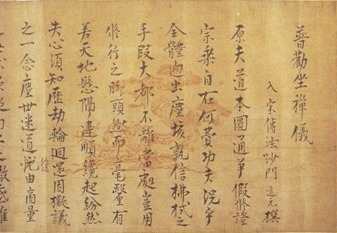
“Fukan Zazen gi” (普勧 坐禅 儀) is a work by Dogen, written around 1227 after he returned to Japan from training in Song-dynasty China. In today’s terms, it is a practical guide to zazen. It does not treat zazen as a mere “means” to enlightenment; it teaches that by “just sitting,” the Way manifests right there.
In world history, 1227 is recorded as the year Genghis Khan, ruler of the Mongol Empire, died—more than two centuries before Columbus reached the Americas.
The text urges zazen for all and is composed of 881 characters over 74 lines.Below is a presentation in contemporary language.
———
The Way (Buddha-Dharma) is already present in everyone and fills the here-and-now. So in truth, there’s no need to add anything or rush to seize a special awakening. Rather than piling up theories or chasing after rare experiences, what matters is the practice of “just sitting.” The ancestral teachers have transmitted this straight path all along.
When you sit, choose a quiet, clean place. Eat and drink lightly enough not to burden the body, and set aside extra concerns for a while. Arrange your sitting gear (zabuton mat and zafu cushion), and wear your robe or clothing loosely. Cross the legs in full lotus or half-lotus. Place the hands in the cosmic mudra (rest one hand atop the other with the thumbs lightly touching) and hold them before the navel.
Keep the torso upright—neither leaning forward nor back—and align the spine. Let ears line up with shoulders, and keep the nose and navel on one line. Place the tongue on the upper palate; the lips and teeth are gently closed. Do not close the eyes—keep them half-open without strain. Let the breath pass quietly through the nose. At the start, sway the body gently left and right and then settle at center.
Here is how to handle the mind. Set aside judgments of good and bad, right and wrong; do not trace the past or chase the future. Don’t strain to “stop thinking,” and don’t aim to “gain a special state.” When thoughts arise, neither follow them nor throw them away—just leave them be. This is called hishiryō, “beyond-thinking,” the activity not measured by thought. This is the very heart of zazen.
This zazen is not a “technique for studying Zen.” It is a path in which body-mind naturally finds ease, and a gate of quiet joy opens on its own. There is no need to split practice and realization and chase them as two. Sit upright, and the principle shows itself; the dust of delusion falls away by itself.
A few cautions. Being satisfied with book knowledge, collecting special states or mystical experiences, or boasting of merit and wonders—all of that misses the point. Do not turn zazen into a private relaxation hack or a way to look good. Zazen is the site where the Way appears as this very body, not something to dress up.
So, sit. Morning and evening, carry out this method faithfully. Even in standing, walking, sitting, and lying down, the heart of zazen continues. This is the straight path handed down directly by the buddhas and ancestors.
———
Dogen’s central aim in urging zazen was to make clear that zazen is not a means to reach enlightenment, but the very place where enlightenment is already manifest.
Zazen is not a tool to acquire awakening; it is the ongoing site where the fact of awakening is confirmed in one’s own body, as taught in Fukan Zazengi.
The mirror metaphor helps: when you polish a clouded mirror, you don’t create the image anew—you see what was already there.
Summary
- Premise of the Way: The Dharma is originally present. Rather than “going to get” awakening, begin with practice (sit).
- Aim: Shikantaza (“just sitting”). Don’t prioritize theories or the hunt for exotic experiences.
- Place & preparation: Quiet, clean spot. Moderate food and drink. Set tasks aside. Loose clothing; arrange sitting gear.
- Posture (legs & hands): Full lotus / half-lotus. Cosmic mudra before the navel.
- Posture (torso): Spine upright. Align ears with shoulders; nose and navel on one line. Slight tuck of the chin.
- Mouth, tongue, eyes: Tongue on upper palate; lips and teeth lightly closed; eyes half-open.
- Breath & settling: Nasal breathing. Gently sway side to side, then settle at center.
- Handling the mind: Leave aside right/wrong and past/future. Neither follow nor discard thoughts = hishiryō (“beyond-thinking”).
- Do not aim for: Special calm, mystic states, merit, “getting enlightenment.” Do not split practice and realization (practice-realization are one).
- Cautions: Don’t drown in doctrinal debate. Don’t turn zazen into a DIY relaxation trick or self-presentation.
- Natural working: Sit upright and the principle shows itself; delusive dust falls away on its own.
- Recommendation: Sit morning and evening; let it permeate standing, walking, sitting, lying down.
- Conclusion: Walk the straight ancestral path of “just sitting.”

コメント