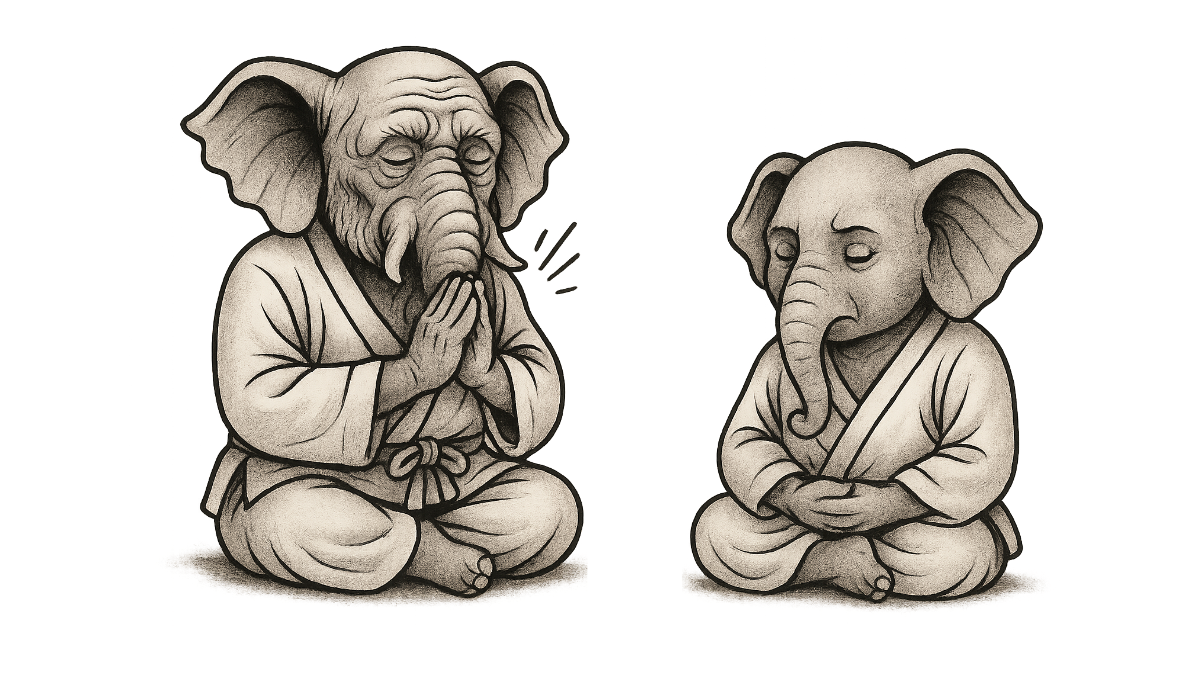
In one phrase: A kōan is “Zenmondo,” a question-and-answer assignment in Zen Buddhism for trainees to attain enlightenment.
The term 禅問答 consists of three characters: 禅 (Zen) + 問 (Question) + 答 (Answer).
Differences Between Schools
In the Rinzai school, Eisai—who established it in Japan around 1191—used koans as the core of training.
Dōgen, who founded the Soto school, placed shikantaza at the center and treated koans as instructive texts.
Why There Are No “Answers” to Koans
A practitioner takes up the assignment given by the teacher and, without clinging to discursive thought or conventional ideas, seeks to realize the truth with the whole body.
A koan has no logical or fixed answer, because it is not a puzzle or a quiz; it is a discipline meant to lead one toward awakening.
Experience is primary. Koans are designed so that no amount of thinking will yield an answer. By engaging a koan earnestly, the practitioner is expected to arrive at a truth that is realized as direct experience—beyond words.
Breaking logical thinking. A koan aims to break logical thought and fixed preconceptions. When faced with a question that ordinary reasoning cannot handle, the practitioner gains new insight beyond existing mental frameworks.
The practice is the process. The goal of a koan is not to reach an answer, but to commit one’s whole being to the process of working with the question. Through this practice, the practitioner looks inward and draws nearer to awakening.
The teacher gauges understanding. Zen teachers assess a student’s depth of realization and spiritual growth through how they respond to a koan. What is tested is not the surface correctness of words, but the practitioner’s state of mind.
A famous koan asks, “When two hands clap there is a sound; what is the sound of one hand?”—known as “The Sound of One Hand.” This is not a question that seeks an answer explainable in words; it is an assignment meant to lead the practitioner to an experience beyond logic.
In this way, a koan is not a mere riddle but a vital practice for realizing a truth beyond the limits of language, and there is no fixed answer.
Other tasks presented in the koan include:
“Does a dog have Buddha-nature?”
“What is Mu?”
“What is Buddha?”
“Is it the wind that moves, or the flag?”
There are many such questions, and even today collections of koans can be found in bookstores.

コメント